

I’ve done several in-person talks at libraries, astronomy groups, and other venues about Europa, and I thought it was about time to write an article about it. Europa is one of my favorite places in the solar system, and hopefully by the end of this article, it will be one of yours as well. So strap in—we’re going on a journey across hundreds of millions of miles to Europa!
Where Is Europa?
Europa is a moon of the biggest planet in our solar system, Jupiter. Jupiter is the fifth planet from the sun, and depending on where it is in its orbit, can be between 390 million to 600 million miles away.
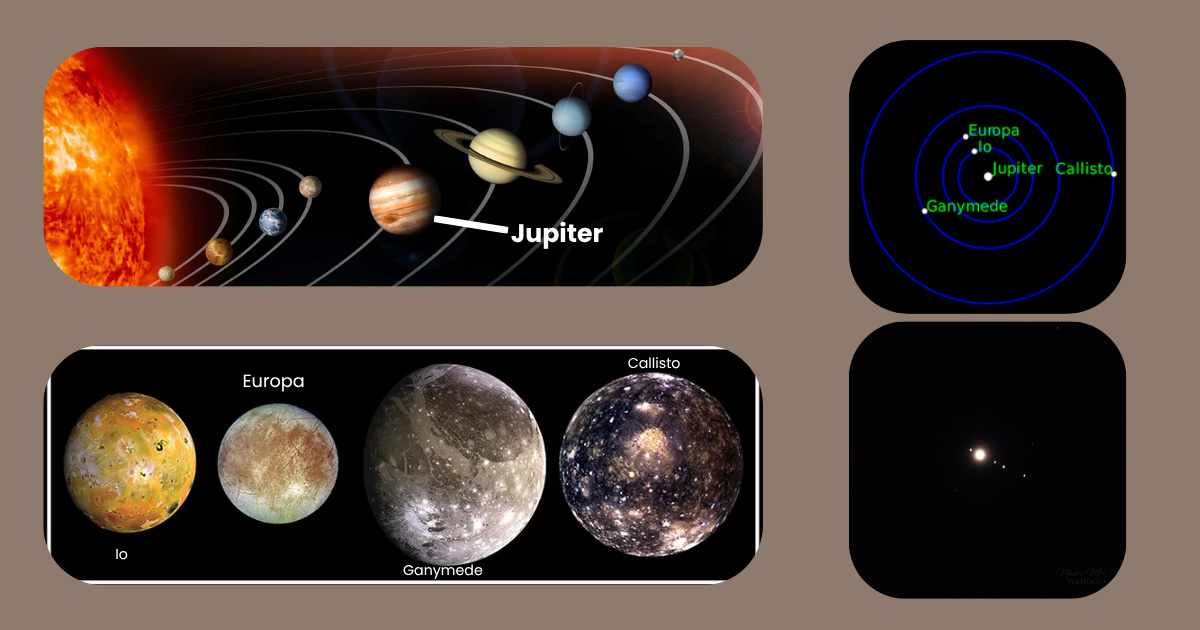
Jupiter had four larger moons, along with over 100 smaller ones. The four bog moons, also called the Galilean moons, are Io, Europa, Ganymede, and Callisto. Europa is the smallest of these moons, and is the second out from the planet. You can see Europa along with the other Galilean moons, through a good pair of binoculars or a small telescope.
A Bit of History
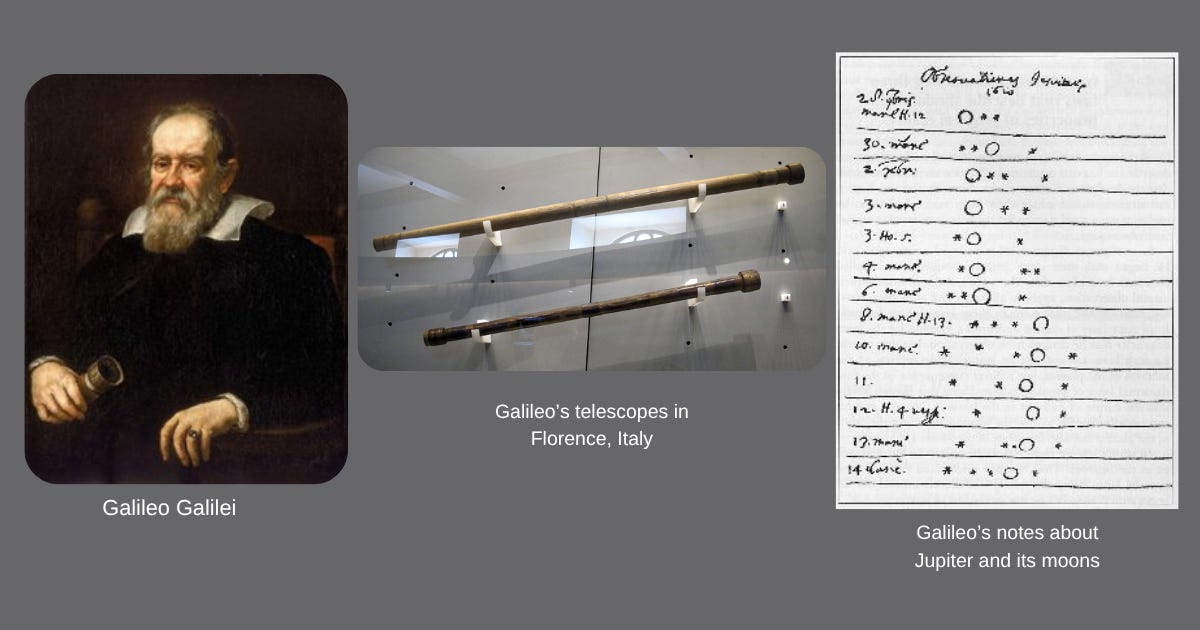
Europa was discovered on January 7, 1610 by Galileo Galilei, the same person who first used a telescope to look at space. He discovered all four of Jupiter’s Galilean moons that day with his homemade telescope, just a few days after he first looked at Jupiter. This changed the way we saw the solar system—even the universe. Until that point, people thought Earth was the only planet to have a moon. We thought we were special. Remember, at that point in time, we barely recognized that Earth wasn’t the center of the universe, and that we revolved around the sun and not the other way around. This was astounding news!
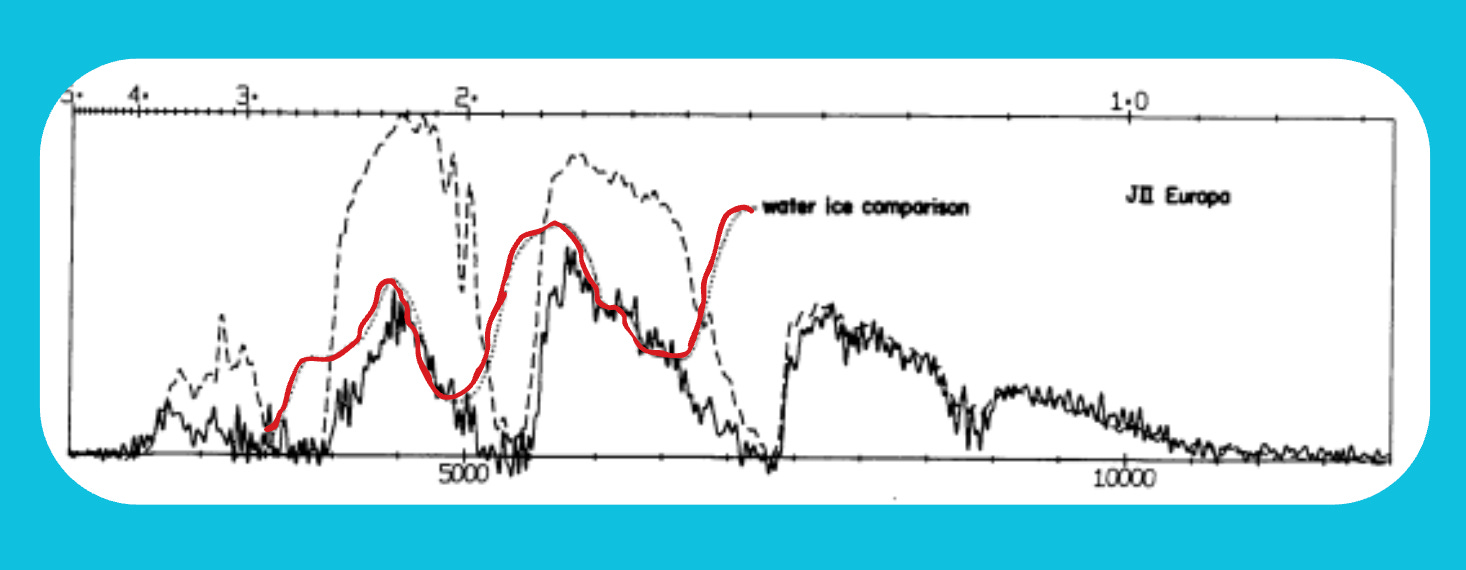
After this discovery, not much more was learned about Europa. We could track its orbit around Jupiter, and that was about it for hundreds of years. In the very early 1970s, however, a couple of astronomers at Kitt Peak National Observatory looked at Europa through their huge telescope and measured the light they observed with a device called a spectrograph to see what Europa might be made of on the surface. They were surprised to find that the spectra from Europa looked very familiar. It was water ice!
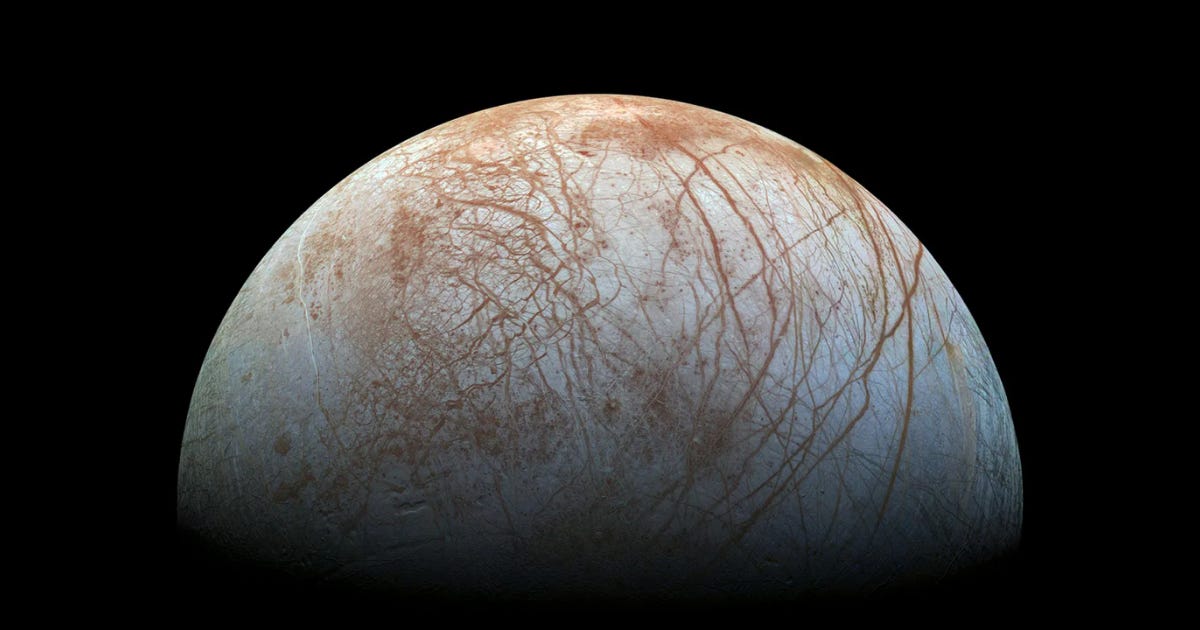
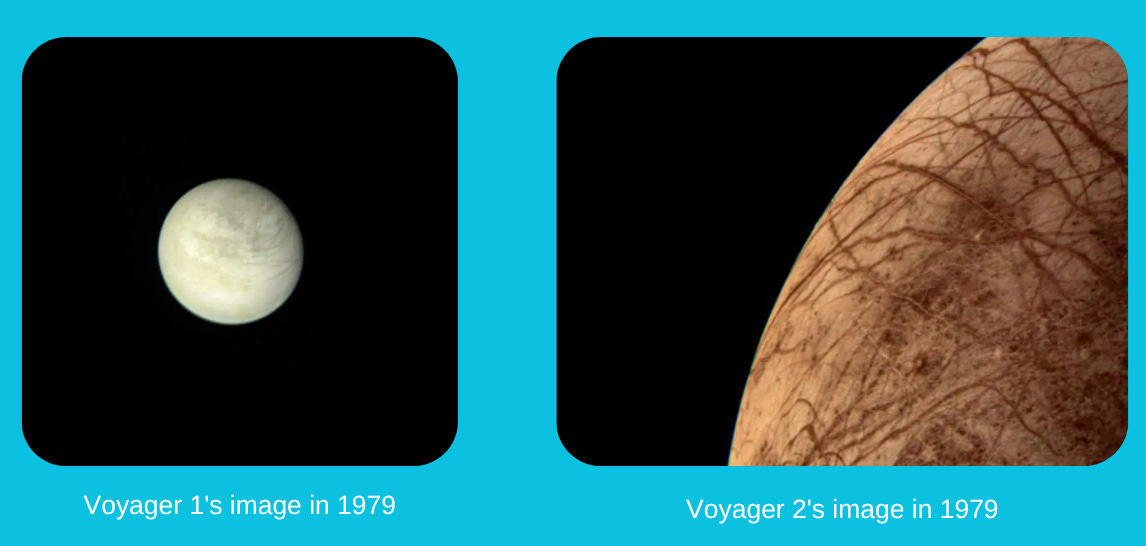
A few years later when the Voyager spacecrafts flew by Europa, we saw the moon like never before. Voyager 1 flew by at about a million miles away and sent back images of a bright reflective moon. But Voyager 2 got much closer, and showed a surface criss-crossed with dark orange-brown lines. Scientists saw very few craters, which they thought was unusual for a moon. They thought maybe this was because the surface was constantly refreshing itself. Perhaps the dark lines were from new material welling up from below the icy surface. We would need to wait about 20 years to find any more answers.
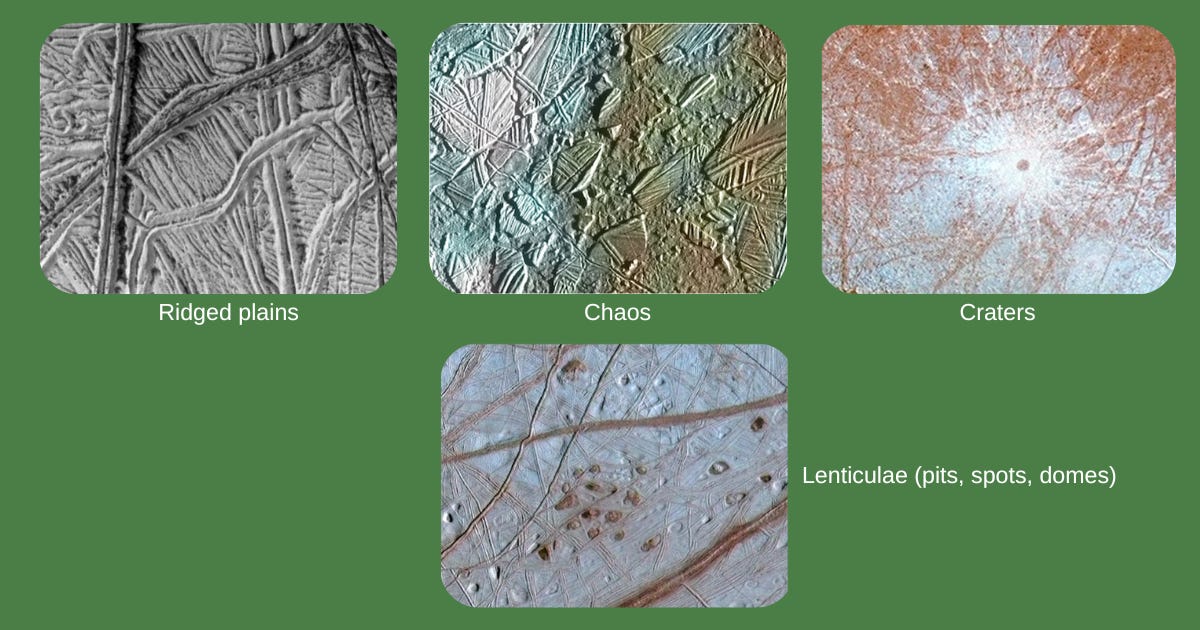
In 1995, the Galileo spacecraft arrived in orbit around Jupiter, taking pictures of the giant planet and its moons. The team of scientists behind the mission thought Europa’s surface was so fascinating they extended the mission an additional two years. The moon’s surface was covered with ridged plains, bumps, pits, and domes called lenticulae, and features they called “chaos,” which looked like jumbled chunks of ice that might have been icebergs.
But that’s not all the Galileo team learned. One of the mission’s goals was to study Jupiter’s magnetic field. While they were observing the giant’s field, however, they saw that it was disrupted wherever Europa was in its orbit. The only explanation they could come up with for this was if Europa had a magnetic field of its own. And in order for that to be possible, there had to be something conductive inside Europa.
Now, Earth has a magnetic field as well, and scientists are pretty certain it is because of the planet’s molten iron-nickel outer core. This fluid metal is conductive, creating a magnetic field. Something similar must be happening on Europa, but that moon is too small and too cold for its core to behave like Earth’s. But there is something else that Europa might have that would be conductive: a liquid salt water layer under it’s thick crust of ice. In other words, an interior ocean!
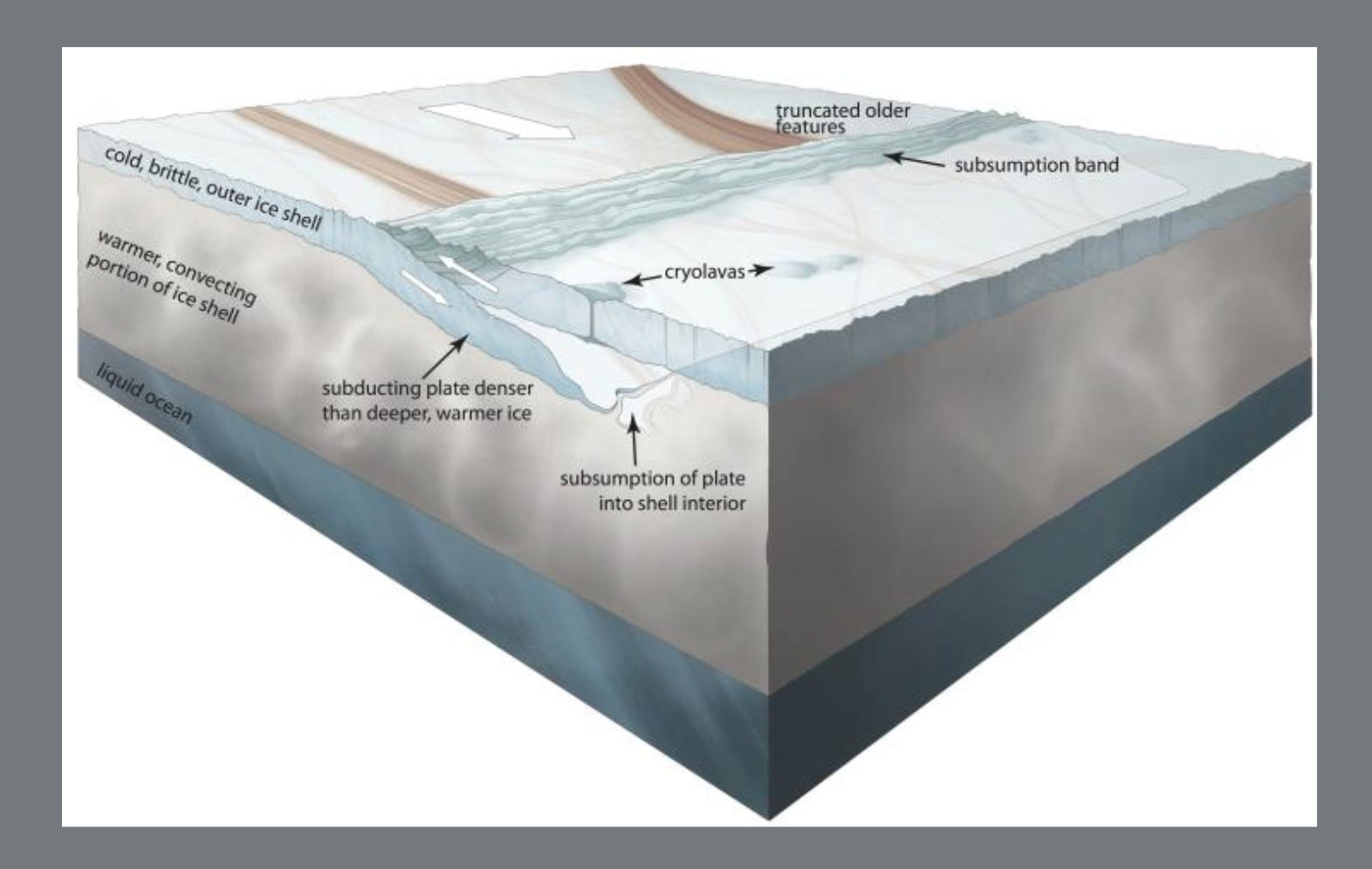
The idea of a fluid interior layer also supports all the cracking and lines on Europa’s surface. The Earth has “cracks” as well, or fault lines, which move over time as the plates in Earth’s crust move over its pliable rock mantle under the crust. It might be possible that between a hard, brittle ice crust and a liquid interior ocean, there is a layer of pliable ice that behaves like Earth’s mantle, expanding in some areas, subducting or going underneath the surface in other areas. This would explain why the surface doesn’t show as many craters as might be expected, because the surface is being renewed. Scientists thought perhaps there might even be icequakes or even ice volcanoes, much like we have volcanoes with lava on Earth. If the mechanism is the same, why not?
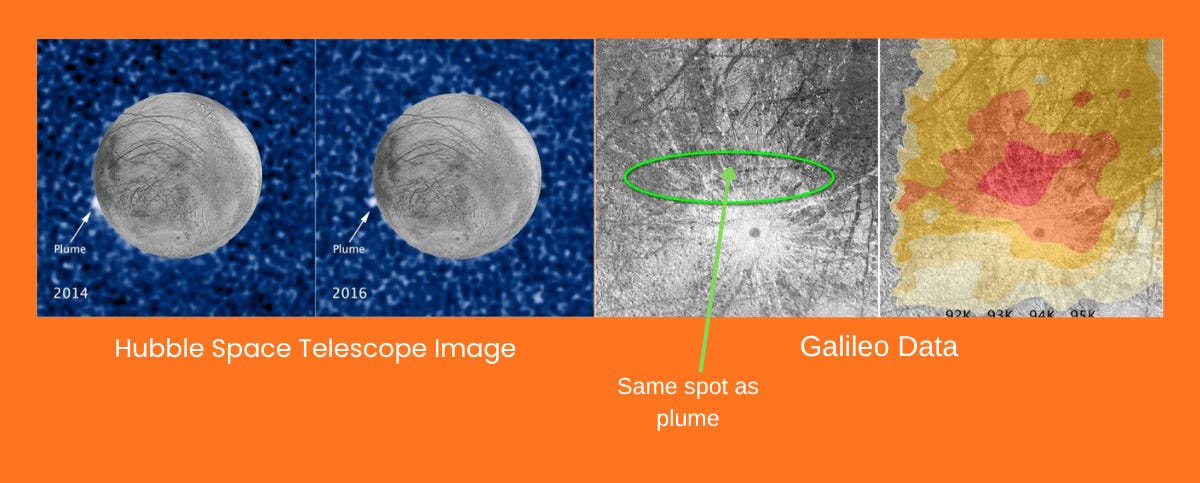
Fast forward to 2014. Scientists pointed the Hubble Space Telescope at Europa to make some observations. In one of the images, they saw a bulge on the side of the moon. Then, in 2016, they saw a similar bulge in the same spot! When they looked back at data from the Galileo mission, they learned that there was a “hot” spot there that was warmer than the surrounding areas (though it was still very, very cold, much colder than anywhere on Earth). The scientists had found their ice volcanoes! This supported the idea that Europa has an interior salt water ocean, containing two times the amount of water on Earth.
Why Is This Important?
So, why is this so important and exciting? It’s just water, right? Well, the only place we are positive there is liquid water is Earth. The only place we know there is life is also Earth. Water is a major building block of life as we know it. If there is water on Europa, perhaps there could be life as well.
In addition to water, life also needs to have certain chemicals as well as energy to metabolize them. Looking at Earth again, our ocean life gets its chemistry from where the water meets the floor of the ocean. The currents of the water mixes up the dirt down there, spreading out nutrients like calcium, sulphur, carbon, oxygen, phosphorous, and more. Microorganisms eat this, and it goes up the whole food chain. It’s not hard to imagine the same thing happening on—or in—Europa. Energy, however, is a little trickier.
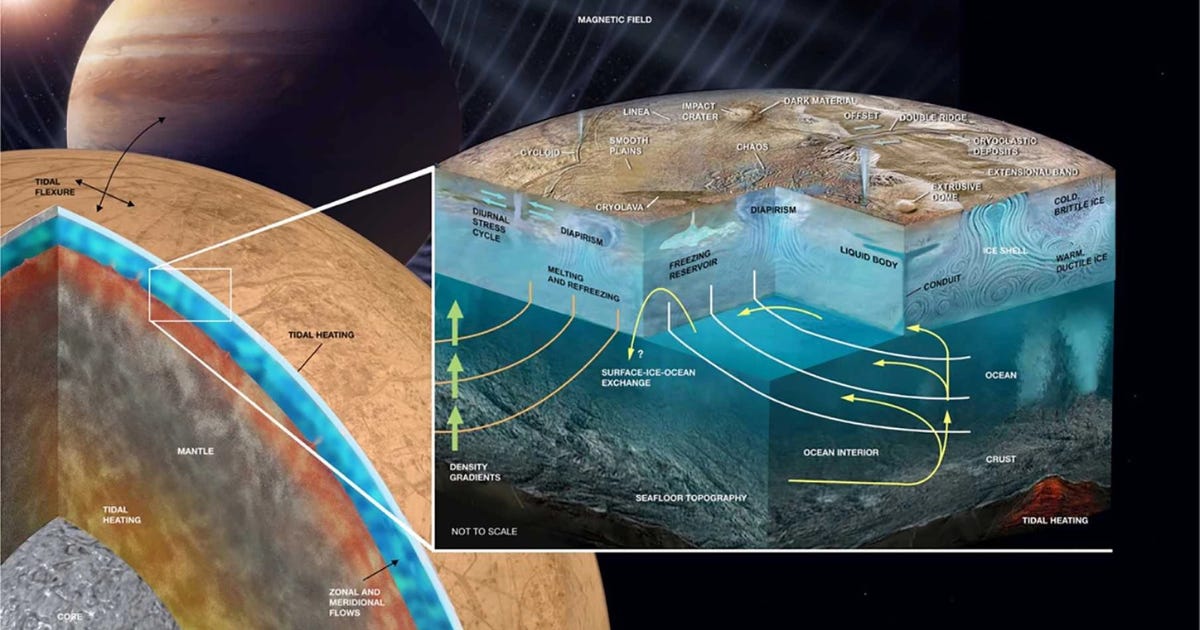
On Earth, we get our energy from the sun. The plants use the sun’s energy to carry out photosynthesis, animals eat the plants, and we eat both the plants and the animals. Europa is very far from the sun, however, and receives much less of its energy. But it has a much closer neighbor that releases a lot of energy as well: Jupiter. The problem is, Jupiter sends off a bit TOO much energy for life to be able to survive on the surface of Europa without becoming completely irradiated. Once again, though, let’s use Earth as an example.
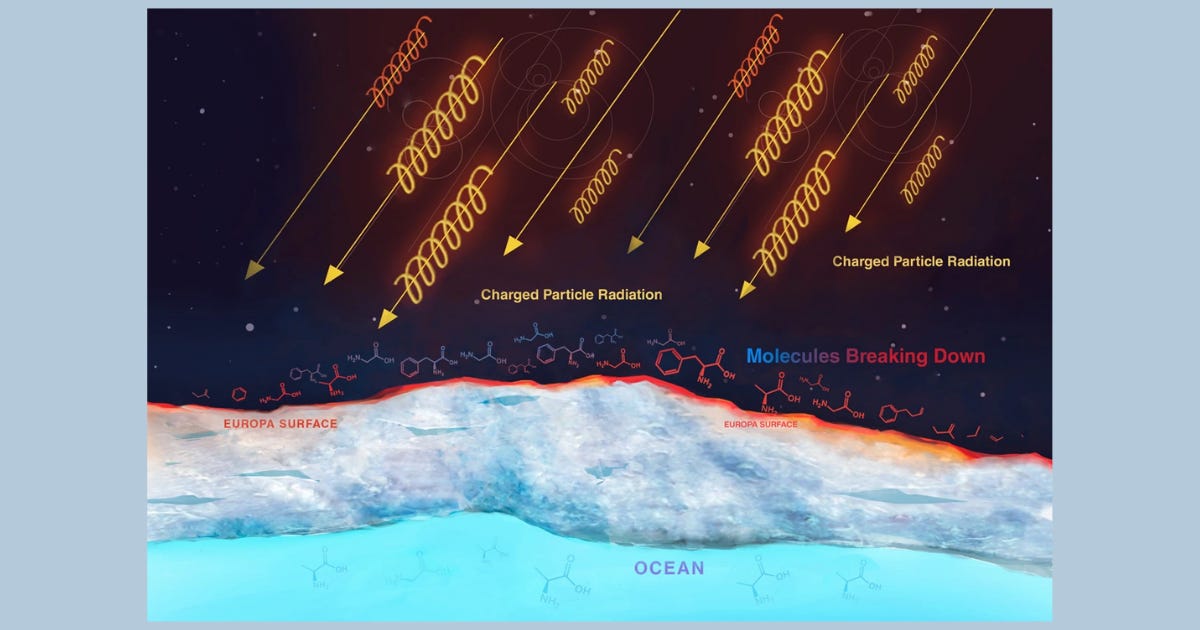
On Earth, we have a nice thick atmosphere that protects us from the sun’s harmful amounts of radiation. We get just the right amount of energy from the sun to survive. If we think about Europa, once more, as a much colder version of Earth, rather than having a gaseous atmosphere, a solid rock crust, and a liquid rock inner layer, Europa could have an ice layer behaving like Earth’s atmosphere over its inner ocean. The ice could protect the ocean below from Jupiter’s harmful radiation. Furthermore, the radiation could break apart molecules on the surface of the ice on Europa, and as the crust on Europa moves and renews, these molecules and ions are brought beneath the surface and into the interior ocean, providing needed chemistry and energy as well. This would provide life in the interior ocean of Europa with everything it needs!
Of course…all of this is basically guesswork. We have good ideas, but how could we prove these ideas true or false? Well…I guess we’re going to have to go back to Europa! But to learn more about that, you’ll have to wait until next week!